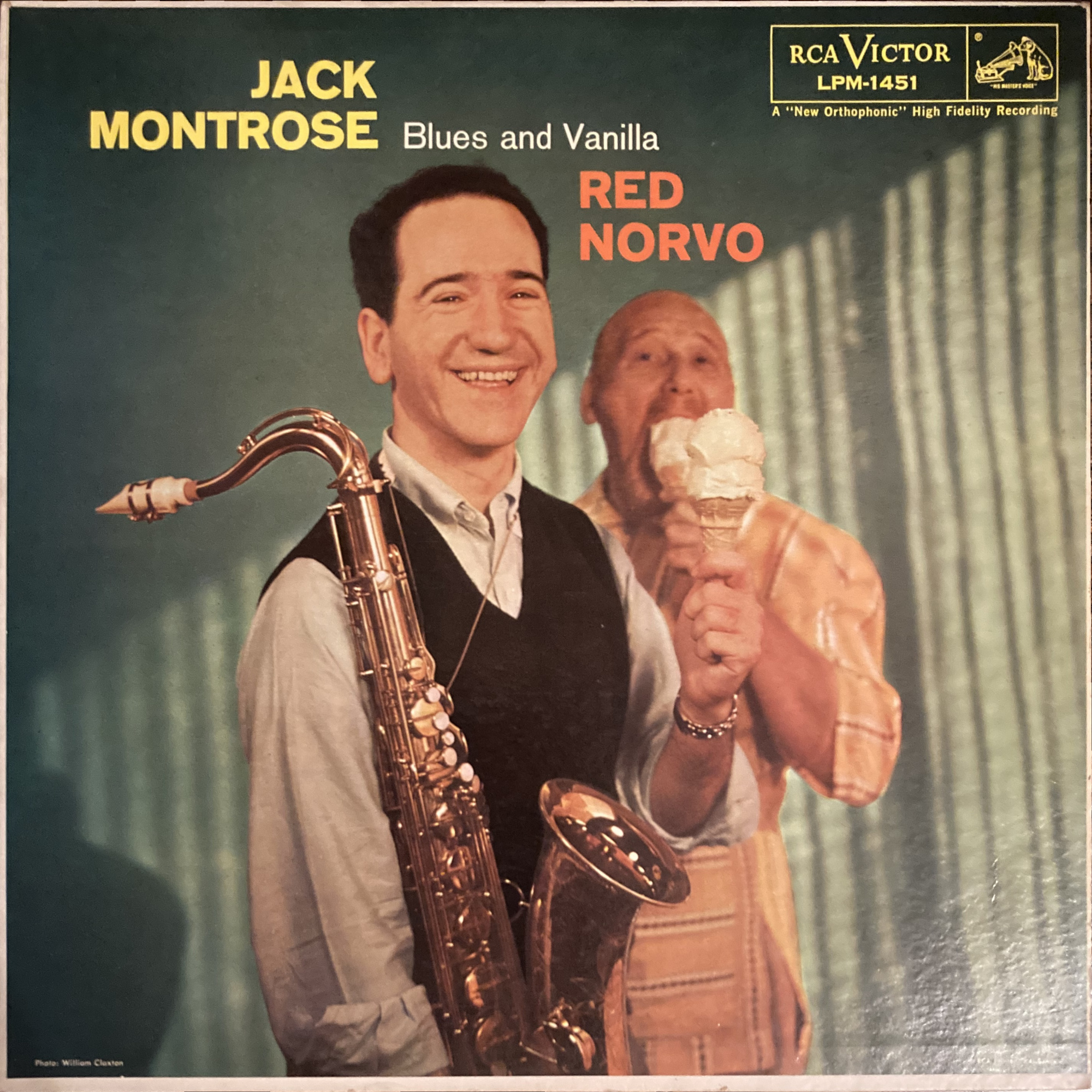
Label: RCA VICTOR
No.: LPM-1451
Title: BLUES AND VANILLA
Musician: JACK MONTROSE
Recorded: 1956
Monaural
Cover address:
Coating 無し
Groove Guard
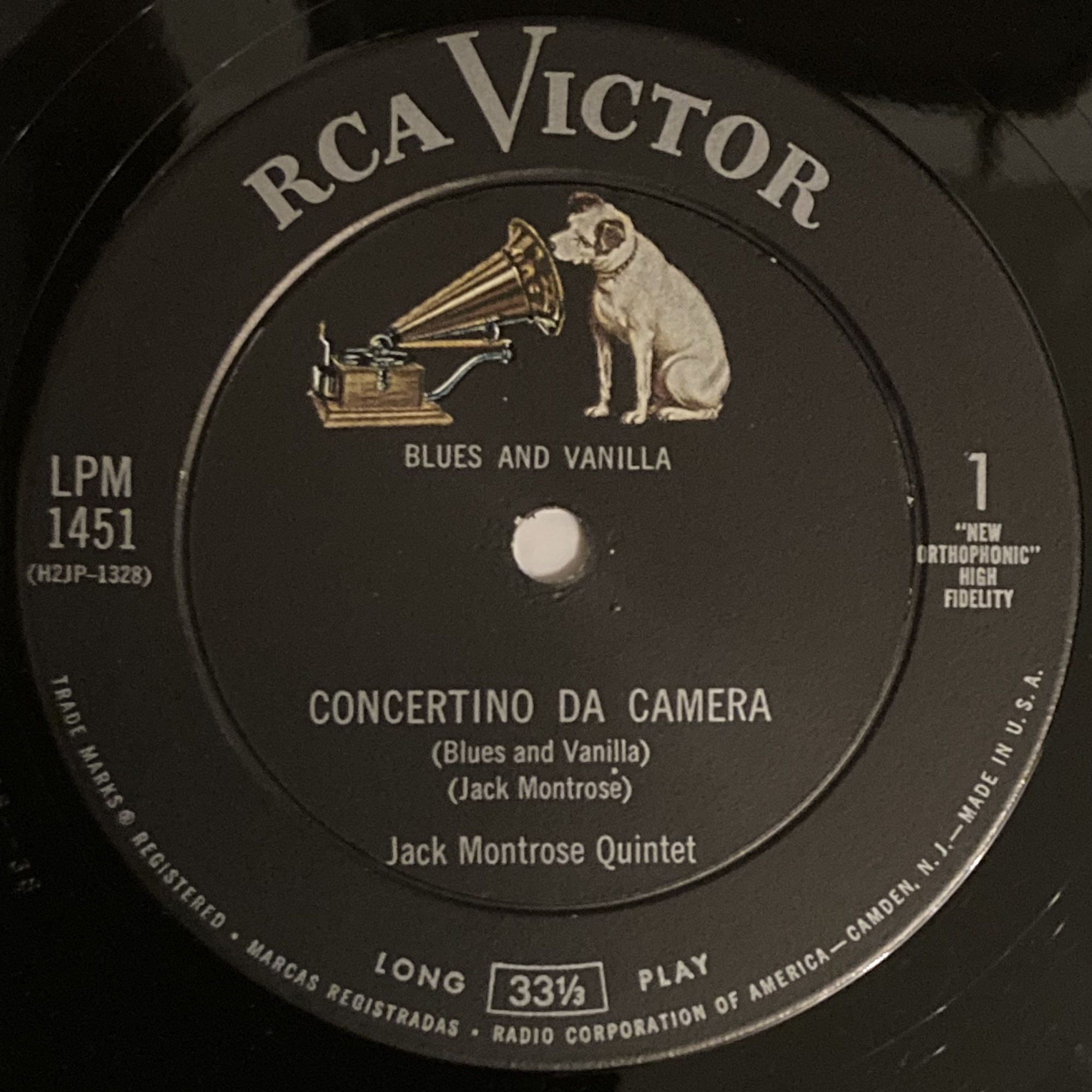
Label Side-1
Black Background
Silver Letter
Address: None
Deep Groove
Dead Wax Info: H2 JP1328–3S, IV
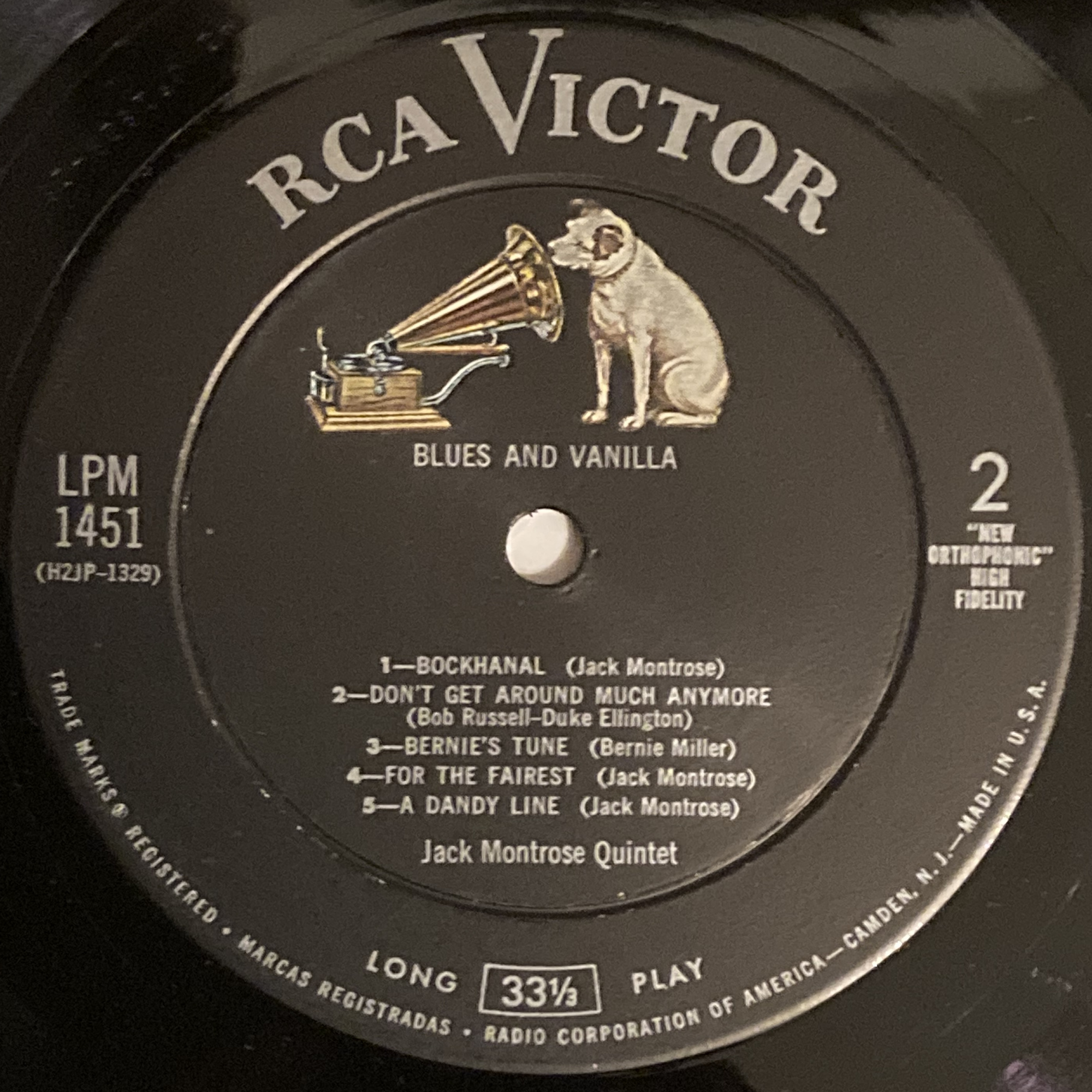
Label Side-2
Black Background
Silver Letter
Address: None
Deep Groove
Dead Wax Info: H2 JP1329–2S, IV
Personnel-
Drums: Shelly Manne, Bill Dolney
Bass: Walter Clark, Max Bennett
Tenor Sax: Jack Montrose
Alto Sax: Joe Miaini
Guitar: James Hall
Vibraphone: Red Norvo
Tracks-
Side-1
1) Concertino Da Camera
Side-2
1) Bockhanal
2) Don’t Get Around Much Anymore
3) Bernie’s Tune
4) For the Fairest
5) A Dandy Line
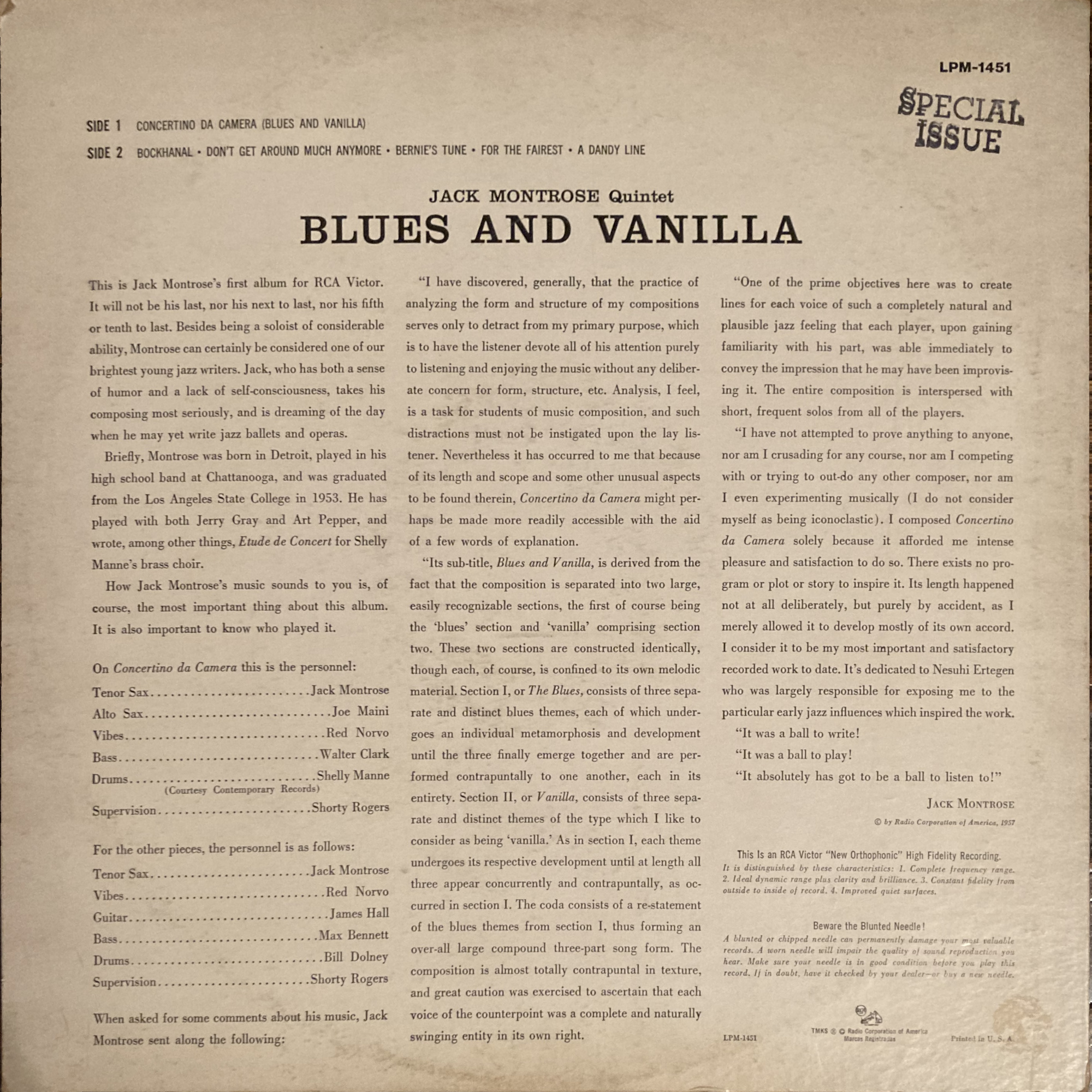
<裏ジャケ原文>
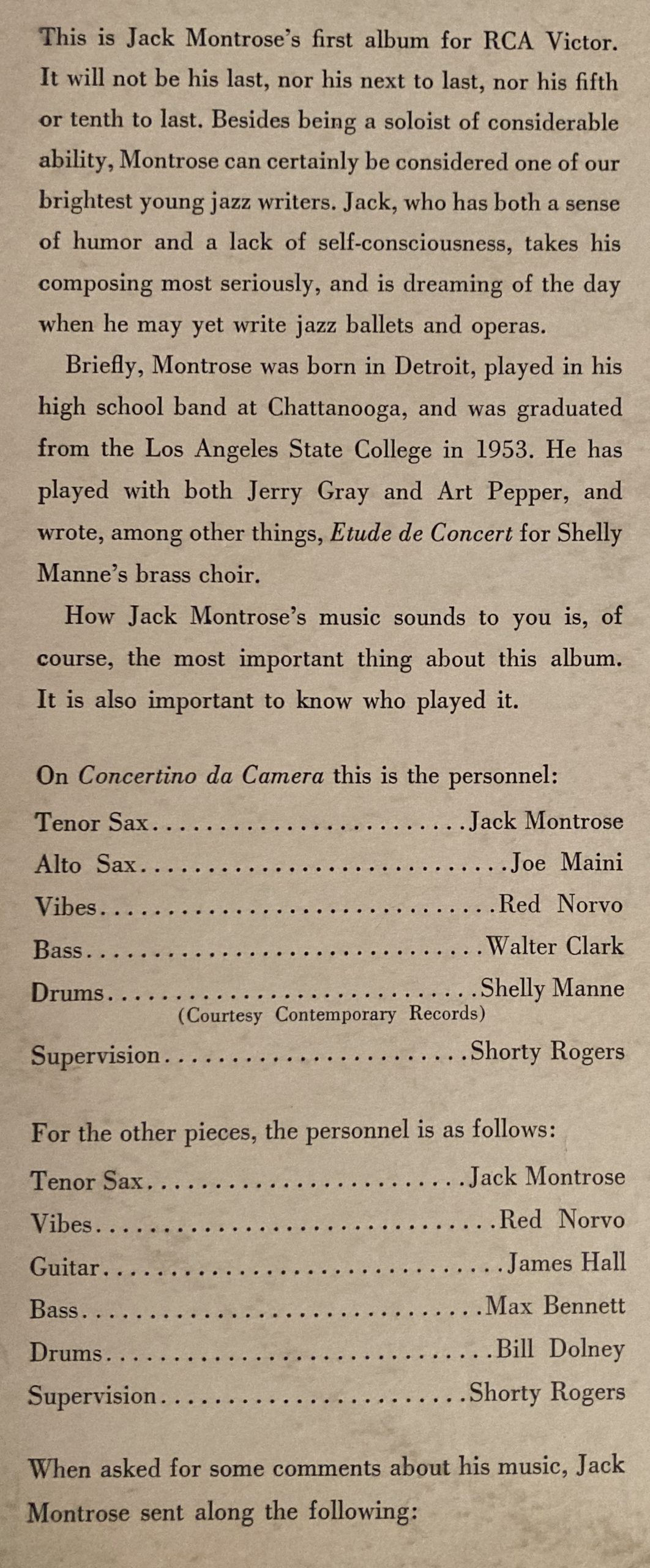
This is Jack Montrose’s first album for RCA Victor. It will not be his last, nor his next to last, nor his fifth or tenth to last. Besides being a soloist of considerable ability, Montrose can certainly be considered one of our brightest young jazz writers. Jack, who has both a sense of humor and a lack of self-consciousness, takes his composing most seriously, and is dreaming of the day when he may yet write jazz ballets and operas.
Briefly, Montrose was born in Detroit, played in his high school band at Chattanooga, and was graduated from the Los Angeles State College in 1953. He has played with both Jerry Gray and Art Pepper, and wrote, among other things, Etude de Concert for Shelly Manne’s brass choir.
How Jack Montrose’s music sounds to you is, of course, the most important thing about this album. It is also important to know who played it.
On Concertino da Camera this is the personnel:
Tenor Sax…… Jack Montrose
Alto Sax……..Joe Maini
Vibes……. Red Norvo
Bass….. Walter Clark
Drums……Shelly Manne
(Courtesy Contemporary Records)
Supervision….
.Shorty Rogers
For the other pieces, the personnel is as follows:
Tenor Sax….. Jack Montrose
Vibes…….Red Norvo
Guitar…….. James Hall
Bass…….Max Bennett
Drums.. Bill Dolney
Supervision….Shorty Rogers
When asked for some comments about his music, Jack
Montrose sent along the following:
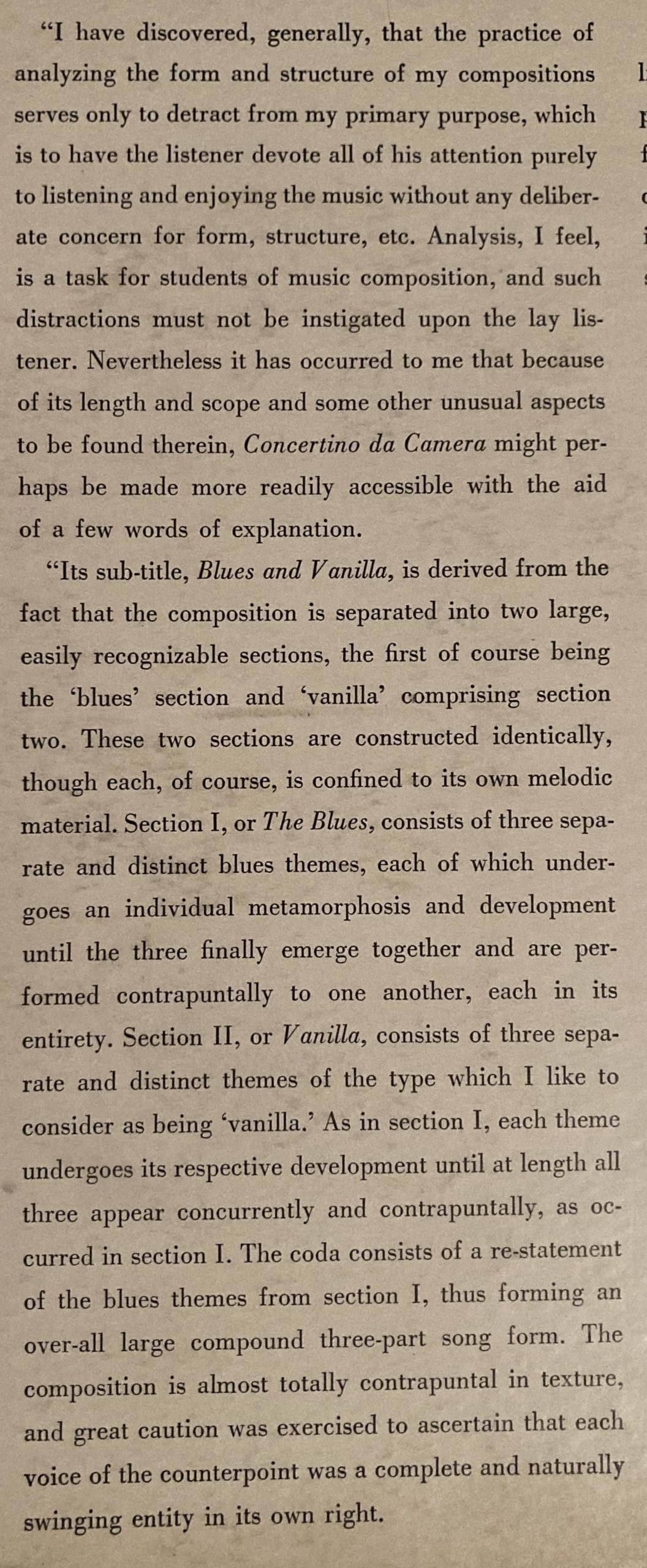
“I have discovered, generally, that the practice of analyzing the form and structure of my compositions serves only to detract from my primary purpose, which is to have the listener devote all of his attention purely to listening and enjoying the music without any deliber- ate concern for form, structure, etc. Analysis, I feel, is a task for students of music composition, and such distractions must not be instigated upon the lay lis- tener. Nevertheless it has occurred to me that because of its length and scope and some other unusual aspects to be found therein, Concertino da Camera might per- haps be made more readily accessible with the aid of a few words of explanation.
“Its sub-title, Blues and Vanilla, is derived from the fact that the composition is separated into two large, easily recognizable sections, the first of course being the ‘blues’ section and ‘vanilla’ comprising section two. These two sections are constructed identically, though each, of course, is confined to its own melodic material. Section I, or The Blues, consists of three sepa- rate and distinct blues themes, each of which under- goes an individual metamorphosis and development until the three finally emerge together and are per- formed contrapuntally to one another, each in its entirety. Section II, or Vanilla, consists of three sepa- rate and distinct themes of the type which I like to consider as being ‘vanilla.’ As in section I, each theme undergoes its respective development until at length all three appear concurrently and contrapuntally, as oc- curred in section I. The coda consists of a re-statement of the blues themes from section I, thus forming an over-all large compound three-part song form. The composition is almost totally contrapuntal in texture, and great caution was exercised to ascertain that each voice of the counterpoint was a complete and naturally swinging entity in its own right.
“One of the prime objectives here was to create lines for each voice of such a completely natural and plausible jazz feeling that each player, upon gaining familiarity with his part, was able immediately to convey the impression that he may have been improvis- ing it. The entire composition is interspersed with short, frequent solos from all of the players.
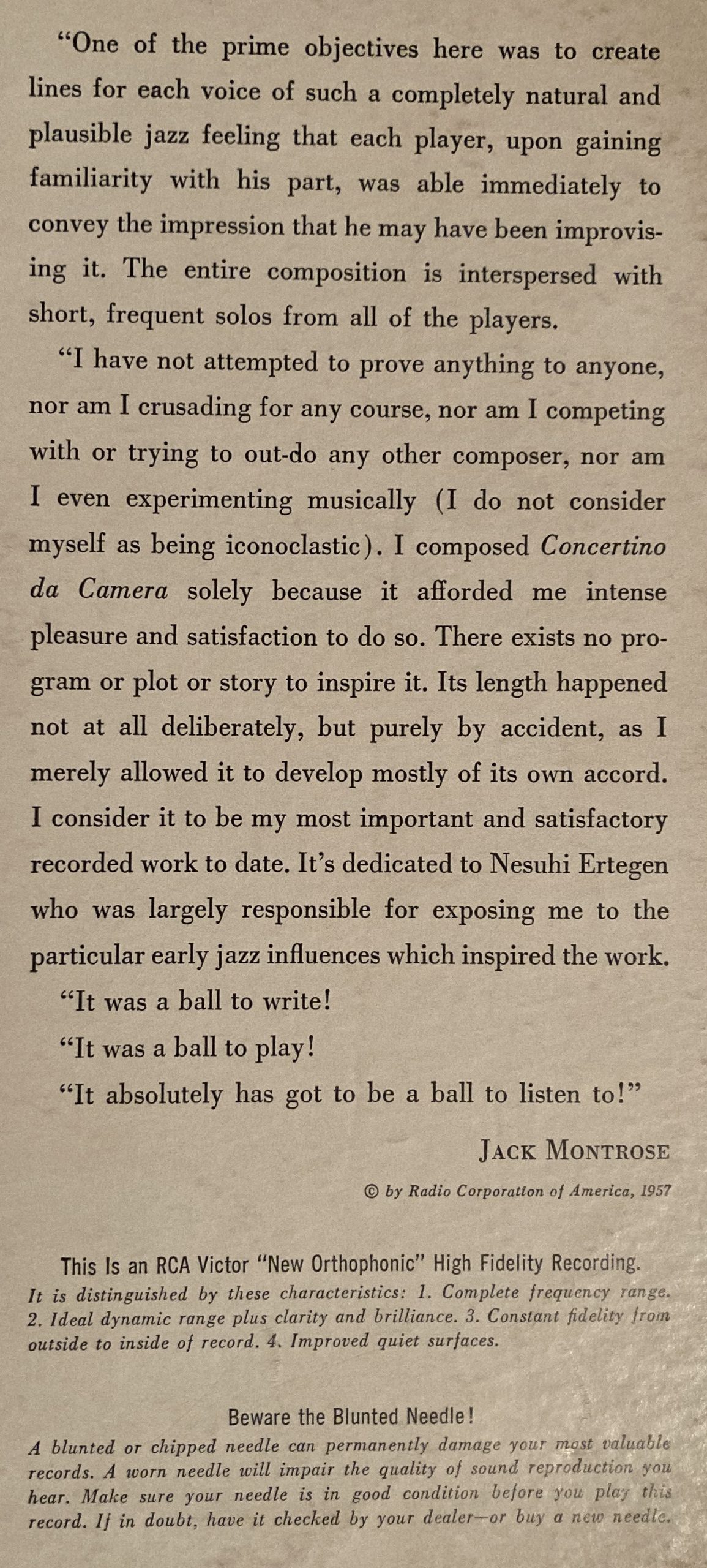
“I have not attempted to prove anything to anyone, nor am I crusading for any course, nor am I competing with or trying to out-do any other composer, nor am I even experimenting musically (I do not consider myself as being iconoclastic). I composed Concertino da Camera solely because it afforded me intense pleasure and satisfaction to do so. There exists no pro- gram or plot or story to inspire it. Its length happened not at all deliberately, but purely by accident, as I merely allowed it to develop mostly of its own accord. I consider it to be my most important and satisfactory recorded work to date. It’s dedicated to Nesuhi Ertegen who was largely responsible for exposing me to the particular early jazz influences which inspired the work. “It was a ball to write!
“It was a ball to play!
“It absolutely has got to be a ball to listen to!”
JACK MONTROSE
by Radio Corporation of America, 1957
This Is an RCA Victor “New Orthophonic” High Fidelity Recording. It is distinguished by these characteristics: 1. Complete frequency range. 2. Ideal dynamic range plus clarity and brilliance. 3. Constant fidelity from outside to inside of record. 4. Improved quiet surfaces.
Beware the Blunted Needle!
A blunted or chipped needle can permanently damage your most valuable records. A worn needle will impair the quality of sound reproduction you hear. Make sure your needle is in good condition before you play this record. If in doubt, have it checked by your dealer-or buy a new needle.
<裏ジャケ和訳>
本作は、ジャック・モントローズにとってRCAビクターでの最初のアルバムである。もちろん、これが最後というわけではないし、最後から2番目、あるいは最後から5番目や10番目といったものでもない。卓越したソロイストであると同時に、モントローズは、現在最も期待される若きジャズ・コンポーザーの一人と言えるだろう。ユーモアのセンスを持ち、気負うことなく自然体でいるジャックだが、作曲に対しては極めて真摯に取り組んでおり、いつかジャズ・バレエやオペラを作曲することを夢見ている。
簡単に経歴を紹介すると、モントローズはデトロイトで生まれ、チャタヌーガの高校でバンド活動を経験し、1953年にロサンゼルス州立大学を卒業した。これまでにジェリー・グレイやアート・ペッパーらと共演したほか、シェリー・マンのブラス・アンサンブルのために『エチュード・ド・コンセール(Etude de Concert)』を作曲するなど、多彩な活動を行っている。
このアルバムを聴いて、ジャック・モントローズの音楽がどのように響くか――それこそが、本作において最も重要なことである。また、誰が演奏しているのかを知ることも大切だろう。
『コンチェルティーノ・ダ・カメラ(Concertino da Camera)』の参加メンバーは以下の通り。
テナー・サックス……ジャック・モントローズ
アルト・サックス……ジョー・マイニ
ヴァイブ……レッド・ノーヴォ
ベース……ウォルター・クラーク
ドラムス……シェリー・マン
(コンテンポラリー・レコード提供)
スーパーバイザー……ショーティ・ロジャース
その他の楽曲の参加メンバーは以下の通り。
テナー・サックス……ジャック・モントローズ
ヴァイブ……レッド・ノーヴォ
ギター……ジェームズ・ホール
ベース……マックス・ベネット
ドラムス……ビル・ドルニー
スーパーバイザー……ショーティ・ロジャース
自身の音楽についてコメントを求められた際、ジャック・モントローズは次のように寄せている。
私はこれまで、自分の作品の形式や構造を分析するという行為は、本来の目的を損なうだけだと感じてきました。私の目的とは、聴き手が形式や構造といったことを意識的に気にすることなく、純粋に音楽を聴き、楽しむことに全神経を集中できるようにすることだからです。分析はあくまで作曲を学ぶ学生が行うべき作業であり、そうした余計なことを一般的な聴き手に押し付けるべきではありません。とはいえ、『コンチェルティーノ・ダ・カメラ(Concertino da Camera)』については、その長さや規模、そしていくつかの特殊な側面を考慮すると、多少の解説を加えることで、より親しみやすくなるのではないかと考えました。
この作品の副題である「ブルース・アンド・バニラ(Blues and Vanilla)」は、曲が大きく二つのセクションに分かれていることに由来します。第一のセクションが「ブルース」、第二のセクションが「バニラ」です。これら二つのセクションは同じ構成をとっていますが、それぞれ独自の旋律素材に基づいています。第一セクション「ブルース」は、それぞれ独立した三つのブルース・テーマから成り立っています。各テーマは個別に変容・発展していき、やがて三つすべてが同時に現れ、対位法的に組み合わされて演奏されます。第二セクション「バニラ」も同様に、私が「バニラ」と呼ぶような、それぞれ独立した三つのテーマで構成されています。第一セクションと同様、各テーマがそれぞれ発展していき、最終的には三つすべてが同時に、対位法的に現れるのです。コーダ(終結部)では、第一セクションのブルース・テーマが再び提示されます。全体として、大きな複合三部形式を成していると言えるでしょう。この作品はほぼ全編にわたって対位法的なテクスチュアで書かれており、対位法を構成する各声部が、それ自体で完結し、自然にスウィングする独立した存在となるよう、細心の注意が払われています。 「ここでの主な目的の一つは、各パートの旋律を、極めて自然かつ説得力のあるジャズの感覚で作り上げることでした。そのため、演奏者は自分のパートに慣れ親しむにつれ、まるで即興で演奏しているかのような印象を即座に与えることができるようになっています。作品全体を通して、各奏者による短いソロが頻繁に織り込まれています。
私は誰かに何かを証明しようとしたわけでも、何かを主張しようとしたわけでもありません。他の作曲家と競ったり、彼らを凌駕しようとしたりしたわけでも、音楽的な実験を試みたわけでもありません(自分を既存の枠組みを打ち破るような人間だとも思っていません)。私が『コンチェルティーノ・ダ・カメラ(Concertino da Camera)』を作曲したのは、単にそうすることが私にとって大きな喜びと満足感をもたらしたからです。この作品には、着想の元となった特定のプログラムや筋書き、物語といったものは存在しません。曲の長さも意図したものではなく、音楽が自然に展開していくままに任せた結果、偶然そうなっただけのことです。私は本作を、これまでに録音した作品の中で最も重要かつ満足のいくものだと考えています。この作品はネスヒ・エルテガン(Nesuhi Ertegun)に捧げられています。彼こそが、この作品のインスピレーションの源となった初期ジャズの数々に私を引き合わせてくれた人物だからです。作曲するのは最高に楽しかった!
演奏するのも最高に楽しかった!
聴くのも、間違いなく最高に楽しいはずです!」
ジャック・モントローズ
RCA(ラジオ・コーポレーション・オブ・アメリカ)、1957年
本作はRCAビクターの「ニュー・オーソフォニック(New Orthophonic)」ハイ・フィデリティ録音盤です。以下の特徴を備えています:1. 完全な周波数帯域。2. 理想的なダイナミック・レンジ、明瞭さ、そして輝きのある音質。3. レコードの外周から内周まで一貫した忠実度。4. 改善された、ノイズの少ない盤面。
摩耗したレコード針にご注意ください!
針先が摩耗したり欠けたりしていると、大切なレコードに修復不可能なダメージを与えてしまう恐れがあります。また、劣化した針は再生音質を損なう原因にもなります。レコードを再生する前に、針の状態が良好であることを必ず確認してください。もし不安がある場合は、販売店で点検してもらうか、新しい針に交換することをお勧めします。
※訳文の制作にはGoogleドライブとGoogle翻訳のお世話になりました。
コメント